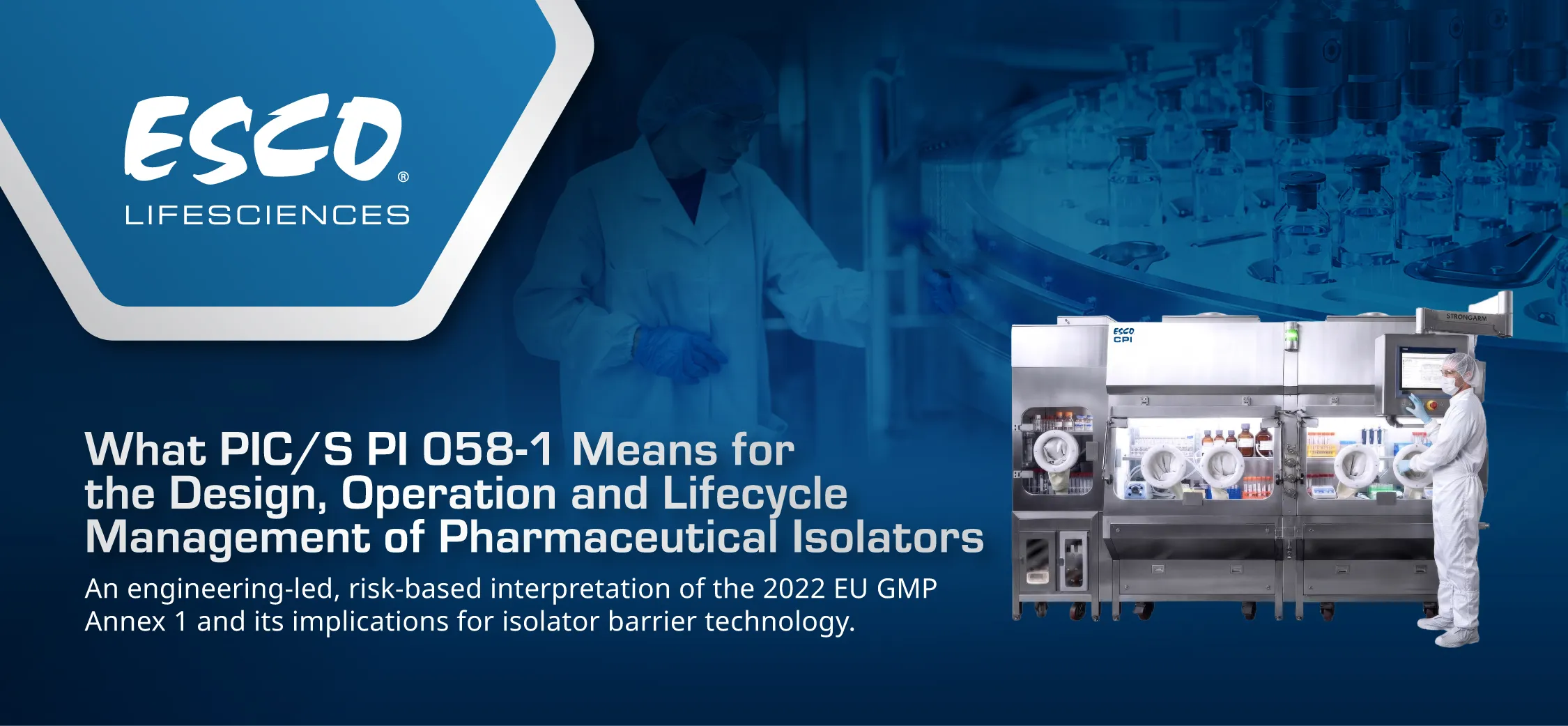
What PIC/S PI 058-1 Means for the Design, Operation and Lifecycle Management of Pharmaceutical Isolators
Introduction: From regulatory expectations to engineering implementation
The 2022 revision of EU GMP Annex 1 strengthened the emphasis on Contamination Control Strategy (CCS), Quality Risk Management (QRM) and the integration of contamination control throughout sterile manufacturing. GMP establishes what manufacturers must achieve, while equipment design, qualification and operation must demonstrate how.
Isolator effectiveness depends not only on physical separation between operators and the critical environment, but also on interconnected systems: airflow management, bio-decontamination, material transfer, automation and environmental monitoring.
On 28 October 2026, PIC/S published Recommendation PI 058-1, which interprets important changes in the 2022 Annex 1 and addresses questions raised during its revision and implementation. It does not introduce an independent set of GMP requirements. It clarifies how existing expectations should be understood and applied.
These clarifications are a chance to reassess whether current equipment designs, qualification strategies and operating practices support the contamination control objectives of Annex 1. The main question is not whether existing barrier systems need to be replaced, but whether their design and performance can be scientifically justified and consistently demonstrated throughout their lifecycle.
Contamination Control Strategy: Is isolator design sufficiently integrated into the CCS?
PI 058-1 clarifies that CCS-related risk assessments for isolators should consider both automated functionalities, such as bio-decontamination, and activities inside the enclosure, including manufacturing operations. For new isolators, these assessments should form part of equipment design, qualification or selection, and be reviewed throughout the lifecycle as knowledge and experience grow.
Would it still be acceptable to bio-decontaminate an isolator manually with sporicidal wipe and a spray? According to the recommendation, no. It’s worth to note that automation can reduce human intervention, but it also introduces failure modes in sensors, control logic, interlocks, alarms and recovery procedures. An automated bio-decontamination cycle may be affected by equipment configuration, agent distribution or inaccessible surfaces. Automated material transfer may introduce risks from incorrect sequencing or interface integrity. Automation therefore should not be taken as evidence of reduced contamination risk. Its contribution must be demonstrated, including how the system responds to abnormal conditions and equipment failures.
For existing isolators, this is an opportunity to check that the CCS reflects the actual equipment configuration and its automated functions. Changes to software, internal equipment or process sequences should also be assessed for their impact on contamination control.
Airflow management: Is 0.45 m/s still the universal engineering target?
Annex 1 paragraph 4.30 gives a guidance airspeed range of 0.36–0.54 m/s for unidirectional airflow. PI 058-1 clarifies that alternative velocities may be justified, provided the requirements for unidirectional airflow are maintained and the rationale is scientifically supported in the CCS. Should the same velocity expectation apply to every isolator application, regardless of process configuration and contamination risk?
The distinction matters most when comparing aseptic filling with closed sterility-testing isolators. In fill-finish, the working position is associated with an exposed sterile product path before final container closure, so first-air protection at a defined velocity is critical. In a closed sterility-testing isolator, the product is already in its primary packaging, and exposure is generally limited to specific, localized interventions such as container puncturing. The duration, location and nature of this exposure are not comparable to an open aseptic filling process.
The implications of this distinction for closed sterility-testing isolators have been explored further in a separate technical discussion, 0.45 m/s ±20% at Working Position in Closed Sterility Testing Isolators: Requirement or Convention?, which examines the regulatory background and engineering rationale behind applying conventional airflow velocity criteria to these applications.
So, the discussion should not be whether 0.45 m/s is inherently right or wrong, but whether it is justified for the intended application. If a different airflow concept can provide the required level of contamination control under specific operating conditions, the decision should be supported by risk assessment, representative airflow visualization and demonstrated protection of critical operations. Air velocity should be a scientifically justified design parameter, not a universal specification applied independently of process risk.
Bio-decontamination and cleaning: Understanding the limitations of VHP and the importance of process validation
Bio-decontamination is one of the most important functions of an isolator. It reduces microbial contamination on internal surfaces and materials to a validated level before aseptic processing begins. PI 058-1 highlights an important point here: surface bio-decontamination should not be confused with sterilization.
The document states that Annex 1 does not list vaporized hydrogen peroxide (VHP) as a sterilization method because of concerns about its robustness and penetration capability. Where sterilization is required, manufacturers should use a validated sterilization method specified in Annex 1 paragraphs 8.50–8.78. An alternative VHP process may only be considered if the manufacturer demonstrates an equivalent level of sterility assurance, taking into account the recognized limitations of the technology: surface cleanliness, surface defects, occluded areas, environmental conditions, and the specific materials or surfaces involved.
This matters particularly for gloves, product-contact equipment and indirect product-contact components. The intended function of the treatment must be established first. If the requirement is sterilization, a validated sterilization process is expected. If it is surface bio-decontamination, a validated bio-decontamination process may be appropriate where Annex 1 permits it.
For an existing installation, the practical value of this clarification is that it forces a precise definition of what each glove is expected to achieve. PI 058-1 addresses the question directly: VHP is not accepted as a sterilant for gloves, but where Annex 1 permits bio-decontamination, a validated VHP process may be used, and the PI gives RABS gloves as its example. The wording matters. It does not say that every glove in every barrier system can rely on VHP alone, so the answer depends on the glove’s role. Is it sterilized before installation and only surface bio-decontaminated afterwards? Does it touch product or product-contact parts? Can it be changed during a campaign without breaking the barrier? Many sites will find these questions are answered informally in practice, and the glove strategy in the CCS often says little more than “bio-decontaminated each cycle.” This is a good point to check that the CCS states how gloves are sterilized or bio-decontaminated, what justifies that choice, and how the validated cycle accounts for finger separation, glove geometry, wear and ageing. The risk is greatest where a legacy glove or sleeve strategy was never written down with its sterilization or bio-decontamination logic made explicit.
It matters even more for complex assemblies. Surface exposure to VHP does not establish that the agent has reached every surface within an assembled component. Contact surfaces, joints, narrow gaps, occluded locations and material characteristics all influence effectiveness. A cycle should therefore not be judged solely by its programmed exposure time or by completion of predefined parameters. Validation should demonstrate that the intended outcome is achieved reproducibly under representative and justified worst-case conditions.
Cleaning and bio-decontamination: Two complementary but different processes
PI 058-1 also clarifies expectations for manual bio-decontamination, commonly encountered in RABS. It can only be acceptable when designed to be reproducible, to cover the entire surface area, and to demonstrate robustness and effectiveness through appropriate validation and regular monitoring.
This should not be stretched into a blanket prohibition of all manual cleaning inside an isolator. Cleaning removes residues, soils and other material that may interfere with subsequent disinfection or bio-decontamination. Bio-decontamination addresses microbial contamination. An effective cleaning programme remains essential to bio-decontamination performance, and Annex 1 itself highlights that cleaning before the bio-decontamination step is essential.
From an engineering perspective, isolator interiors should be designed to facilitate effective cleaning and reproducible bio-decontamination. Surface geometry, internal structures, equipment positioning, joints, crevices and accessibility should all be considered during design.
Residue management and product compatibility
PI 058-1 also addresses the potential adverse impact of cleaning and bio-decontamination agents on the product. Procedures should include effective removal of cleaning and disinfectant residues, including sporicidal agents. For isolators, validation data should show that the residual sporicidal agent at the end of the cycle is below concentration that could adversely affect product quality and stability. What must be checked is not only that the aeration end point is safe for the operator, but that it is safe for the product and process.
The assessment should also consider ingress of the agent into containers, goods or materials present during bio-decontamination. PIC/S gives the example of aseptic compounding, where products, syringes and bags may be exposed. The question goes beyond residue on equipment surfaces: could the agent enter materials or containers and subsequently affect the product?
For sensitive formulations, even a low level of residual chemical exposure may warrant evaluation, depending on chemical stability and compatibility. Repeated exposure of equipment materials to disinfectants and sporicidal agents may also affect surface integrity, material compatibility and long-term performance. The assessment should therefore link the bio-decontamination cycle, material selection, product characteristics and operating conditions.
Hydrogen peroxide delivery technologies: Does regulatory familiarity imply technological preference?
PI 058-1 refers to VHP in several contexts, particularly surface bio-decontamination and its limits as a sterilization method, reflecting established regulatory familiarity. The FDA’s 2004 Aseptic Processing Guidance likewise discusses multiple vaporized agents for isolator decontamination and stresses process development and validation. However, these references should not be read as an endorsement of VHP as inherently superior or as the only acceptable delivery technology.
Aerosolized (AHP) and nebulized (NHP) hydrogen peroxide use different delivery approaches, which may influence agent distribution, surface exposure, condensation behavior, material compatibility and cycle performance. These are important engineering considerations, but they do not by themselves establish that one technology is more effective than another.
The distinction should be between regulatory familiarity and demonstrated process performance. AHP, NHP and VHP should each be evaluated by operating principle, intended application and validated performance. The objective is not necessarily to show equivalence to VHP, but to show that the chosen technology consistently achieves the required outcome under representative and worst-case conditions. The choice should be driven by scientific evidence, process requirements and the CCS, not by how often a technology appears in guidance.
These considerations are part of a broader bio-decontamination strategy that extends beyond cycle validation alone. In our white paper, Developing a Science- and Risk-Based Bio-decontamination Control Strategy for Pharmaceutical Isolators, we explore these aspects in greater detail, covering technology selection, cycle development, residue management, validation and continued performance monitoring within an integrated Contamination Control Strategy.
Material transfer: The barrier is only as effective as its transfer strategy
Material transfer creates a potential pathway for contamination into an otherwise controlled environment. Barrier systems separate operators from critical areas, but materials, equipment and components must still be introduced through controlled transfer arrangements.
PI 058-1 clarifies that validation must demonstrate that transfer is achieved without introducing contamination. This includes verification of effective transfer methods, validated sterilization or disinfection, properly sealed packaging, rapid transfer systems for isolators, and bacterial retention filters where applicable. Transfer is therefore an integral part of the contamination control system, not an auxiliary function.
For isolators, rapid transfer systems such as alpha-beta ports provide a controlled interface between the external and enclosed environments. Their effectiveness depends on interface integrity, correct connection procedures, decontamination of transfer surfaces, and prevention of incorrect or premature opening. Pass-through chambers and transfer bags likewise require validation of their intended transfer process.
The transfer strategy should be considered at initial design. Size and frequency of transfers, component dimensions, transfer orientation, packaging configuration and potential operator intervention all influence the choice of system. Validation should also reflect the actual routine process: a successful connection under ideal conditions may not be enough if routine operation involves different materials, packaging or operator activities.
PI 058-1 also addresses whether materials must always pass through every cleanroom grade in sequence. It confirms that strict adherence to the cleanliness cascade is not always necessary when transferring into higher-grade cleanrooms. Under certain circumstances a grade may be skipped for transfers into Grade C, provided the applicable Annex 1 requirements are fully met. This is not a general permission to bypass controls: the transfer must still demonstrate that contamination is not introduced, and that environmental and material controls are maintained.
Environmental monitoring: Understanding the significance of particles ≥5.0 µm
Environmental monitoring shows the condition of the manufacturing environment and the continued effectiveness of controls. Particle monitoring requirements have historically raised questions, particularly about maximum limits for ≥5.0 µm particles during classification and requalification.
PI 058-1 clarifies that maximum limits for ≥5.0 µm particles are not a default requirement when classifying Grade A (at rest and in operation) and Grade B (at rest). This does not remove the need to monitor them: monitoring against defined limits remains required during routine operation. Their inclusion in classification and requalification should be considered where indicated by the CCS or historical trends, and where maximum limits are not established, the decision should be documented and justified in the CCS.
In isolators and RABS, particle generation can be influenced by the equipment itself and by activities inside the barrier: mechanical movement, glove manipulation, conveyors, robotics, powder handling and material transfer. ≥5.0 µm particles can therefore be useful when evaluating unusual equipment behavior or process changes. However, non-viable particle monitoring is not a direct measurement of microbial contamination, so it should be considered alongside viable monitoring, equipment performance data, interventions and historical trends.
Sampling locations should also be chosen carefully. They should give meaningful information about the environment around critical operations without interfering with airflow protection or the process. Points near moving components may reveal equipment-related particle generation, while points near filling operations show the environment in which exposed product is handled. Each location should be justified against process and contamination risk.
Sampling flow rate is a quieter issue that matters especially in smaller isolators. PI 058-1 states that using a lower flow rate for total particle monitoring is generally not acceptable, pointing to the 28 liters per minute minimum in Annex 1. Particle counters with lower flow rates are common in compact isolators because they draw less air and are easier to integrate. For an existing isolator, the question is whether the counters installed today meet that minimum, and if not, whether the justification for the lower rate would stand up. Moving to 28 L/min brings engineering consequences in a small enclosure: the probe takes more air out of the working zone, so its position and its effect on airflow patterns and pressure need checking, ideally with visualization, rather than assuming it is neutral. Sample tubing length and bends also affect particle transport, so the layout needs to be considered together with the counter. And where the counter sits outside the isolator, its connection must preserve integrity and tolerate bio-decontamination. These are best checked during a planned re-qualification or change-control event, before an inspector raises the question.
Equipment configuration during classification: Does qualification represent the actual operating environment?
Equipment installed in a cleanroom or barrier system can influence airflow distribution and particle measurements. PI 058-1 clarifies that:
- equipment intended for use in the area should be installed before classification;
- equipment intended to operate during routine activities should be operating during in-operation classification;
- equipment normally switched off when activities are not occurring should be off during at-rest qualification.
This is particularly relevant for isolators with filling systems, conveyors, robotic arms and pumps. An airflow study without representative equipment configurations, or particle classification without equipment operating as intended, may not reflect actual conditions.
Manufacturers should therefore consider installation sequence, equipment interfaces, operational modes and the impact of modifications on existing qualification evidence. Adding a robotic arm or modifying a conveyor may change local airflow patterns and may warrant additional airflow visualization or particle measurements.
QC microbiological testing: Does a closed isolator remove the need for a classified surrounding room?
Closed isolators are widely used in QC laboratories for sterility testing, and their enclosed design can reduce the influence of the surrounding laboratory. The classification requirements for that laboratory have long been debated.
PI 058-1 clarifies that when a closed isolator is used and meets aseptic conditions, the surrounding QC laboratory must ensure it does not negatively affect the testing process or its results. The configuration should be reflected in the CCS and supported by a scientifically and technically justified risk assessment demonstrating an appropriate state of control. The suitability of the surrounding environment is therefore evaluated by its potential impact on the isolator and the test, rather than by assuming a particular room classification is always required.
This is not an automatic exemption from environmental controls, nor permission to operate every closed isolator in an uncontrolled environment. The surrounding laboratory remains part of the contamination control system. Isolator integrity, pressure relationships, material transfer, glove integrity, environmental conditions and operator activities should all be considered, with particular attention to external contamination causing false positives. The risk assessment should also cover how materials enter and leave the isolator and whether the room supports the integrity of the closed system.
From an engineering perspective, sterility testing isolators should be designed as complete systems rather than evaluated independently of their surroundings.
Implications for existing isolator systems: A lifecycle approach to contamination control
PI 058-1 should not automatically be read as requiring redesigning existing isolators. However, it’s important to highlight that all Annex 1 requirements should be fulfilled by all manufacturers. Where a site could not meet a requirement at publication, a risk-based assessment of the non-compliant situation should be performed, interim actions defined to mitigate the risks, and an appropriate timeframe set to bring the facility into a compliant situation. A system designed and qualified years ago may still provide appropriate contamination control, provided its qualification evidence remains representative of its current configuration and operating conditions.
Performance can change over the lifecycle. Repeated bio-decontamination may affect material integrity, equipment modifications may alter airflow, and changes to processes, automation, transfer arrangements or interventions may introduce new contamination pathways or invalidate the original risk assessment. The CCS should give a structured understanding of how the equipment contributes to contamination prevention and how that contribution is maintained.
PI 058-1 further clarifies that CCS effectiveness should be reviewed on an ongoing basis, at least annually, and after significant changes, deviations and emerging problems, as well as during periodic product quality reviews. It also confirms that the CCS need not exist as a single document, provided the relevant control systems are identified, managed and their interactions understood.
PI 058-1 also makes clear that ISO standards do not replace Annex 1 requirements. For example, the once-per-year aseptic process simulation option in ISO 13408-1 for highly validated isolators does not override Annex 1, which normally expects APS to be repeated at least twice per year for each aseptic process, filling line and shift. Manufacturers should therefore not assume that isolator technology alone permits reduced APS frequency.
Equipment manufacturers can strengthen lifecycle support beyond delivery and qualification by providing information on material compatibility, airflow performance, maintenance requirements, bio-decontamination capabilities and critical parameters. Pharmaceutical manufacturers should evaluate the isolator as part of the wider manufacturing process, not as an independent piece of equipment.

Ultimately, the objective is not to increase the number of validation activities or introduce additional engineering specifications without justification. It is to ensure that the existing controls are appropriate, effective, and supported by evidence.
Conclusion: From meeting specifications to demonstrating contamination control performance
PI 058-1 gives a more harmonized understanding of existing Annex 1 expectations without adding new requirements. These considerations are interconnected: airflow is influenced by equipment configuration, bio-decontamination by surface accessibility and material characteristics, and barrier integrity by transfer arrangements. Isolator effectiveness therefore cannot be established through a single parameter or qualification test. It requires an integrated assessment of equipment, process, operating practices and supporting controls.
Annex 1 remains the governing GMP reference. Risk-based justification is a scientifically sound way to demonstrate how its requirements are achieved, not a way of avoiding them. The objective is unchanged: to protect the product, maintain the required state of contamination control, and ensure the consistent manufacture of safe sterile medicinal products. The question for the industry is not simply whether existing isolators and RABS comply with predefined specifications, but whether their design, operation and lifecycle management provide sufficient evidence that the contamination control objectives of Annex 1 are consistently achieved.
Disclaimer
This article is an engineering-led reading of PIC/S PI 058-1 and EU GMP Annex 1 and is intended to help manufacturers think through the implications for their own isolators and barrier systems. It paraphrases and interprets the PI 058-1 Q&As in light of the author’s experience and is not a substitute for the primary texts. Readers should consult PI 058-1, Annex 1 and their national inspectorate for authoritative requirements, and should assess the relevance to their own processes, equipment and contamination control strategy. Nothing here constitutes regulatory or legal advice.
Reference
- Pharmaceutical Inspection Co-operation Scheme (PIC/S). (2026). PI 058-1: Recommendation – Interpretation of the Most Important Changes in the Annex 1 on the Manufacture of Sterile Products (2022). 28 October 2026.
- European Commission. (2022). EudraLex Volume 4, EU Guidelines for Good Manufacturing Practice, Annex 1: Manufacture of Sterile Medicinal Products. August 2022.