Esco Lifesciences Launches OxAP: An Integrated Aseptic Isolator with Nebulized Hydrogen Peroxide Bio-Decontamination
Aseptic operations depend on more than a clean working environment. Preparing the chamber, transferring materials, verifying integrity, and documenting each cycle all contribute to consistent contamination control.
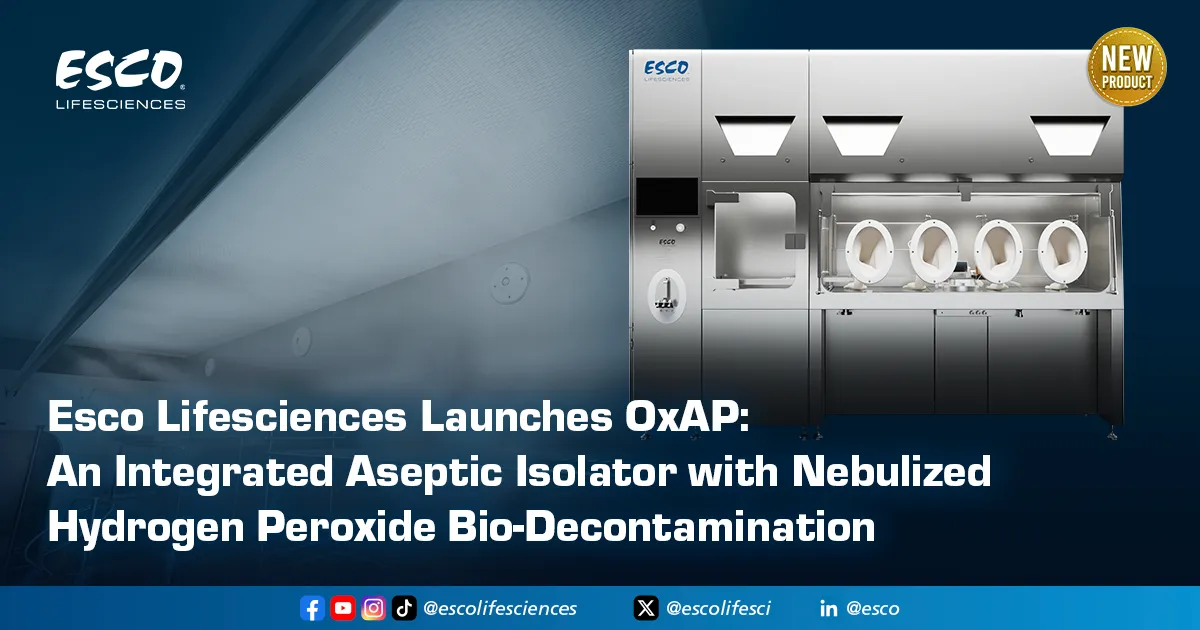
Esco Lifesciences introduces the Operational Excellence Aseptic Platform Isolator (OxAP), bringing these functions together in a positive-pressure platform designed for aseptic processing and sterile product handling. Combining a Grade A / ISO Class 5 main chamber with integrated nebulized hydrogen peroxide bio-decontamination, controlled material transfer, and centralized automation, OxAP helps manufacturers implement their contamination control strategy and support EU GMP Annex 1 compliance.
Designed for aseptic processing and product protection
OxAP provides a physically separated working environment in which operators handle materials through glove ports, limiting direct interaction between the critical process, personnel, and the surrounding room.
Its intended applications include aseptic processing, aseptic filling, cell processing, and aseptic material transfer, subject to the requirements and qualification of the specific process. Within the Ox family, the Operational Excellence Sterility Testing Isolator (OxST) provides the configuration for sterility-testing workflows.
The four-glove main chamber offers a 1900 mm-wide working zone, with one or two dedicated transfer chambers available to accommodate different facility layouts and material flows. Positive operating pressures of +40 ± 5 Pa in the main chamber and +20 ± 5 Pa in the transfer chambers help resist contamination ingress from the surrounding environment.
Integrated NHP bio-decontamination for efficient preparation
A central feature of the Ox platform is its integrated Nebulized Hydrogen Peroxide (NHP) system, designed to achieve a minimum 6-log reduction of microbial through cycles validated for the applicable chamber and load configuration.
The system uses piezoelectric vibrating-mesh technology to generate a fine hydrogen peroxide aerosol at ambient temperature. The droplets evaporate, distributing hydrogen peroxide throughout the enclosure to contact exposed surfaces. Catalytic aeration then removes residual peroxide before operations resume.
The platform’s reported bio-decontamination performance includes a complete cycle of under 30 minutes for a 1.352 m³ chamber under empty-load conditions. Actual cycle duration depends on the load, material compatibility, chamber configuration, and validated process parameters.
The nebulizer requires no compressed air or heated vaporizer, simplifying integration and limiting additional heat input into the chamber. The isolator itself still requires a compressed-air supply..
Each cycle records the mass of hydrogen peroxide delivered alongside time, temperature, and relative humidity, providing a traceable record of the treatment.
Controlled transfers that preserve separation
Material movement is built into the OxAP operating workflow. Dedicated transfer chambers allow materials to enter and leave without opening the main working chamber directly to the room during normal operation.
Materials are placed on a sliding tray inside the transfer chamber. After the outer door closes and seals, the chamber completes its bio-decontamination sequence before the inner-door interlock releases. The tray extends toward the main chamber, bringing materials within easier reach and helping reduce glove fatigue.
Interlocked inner and outer doors prevent simultaneous opening. Inflatable door seals support chamber integrity, while sliding internal doors minimize intrusion into the working area.
Two bio-decontamination modes support preparation and ongoing transfers:
- Master Decontamination: includes treatment of the main chamber together with the transfer chambers, typically before operations begin.
- Transfer Chamber Decontamination: enables dedicated transfer-chamber treatment without repeating a full master cycle for every transfer.
This arrangement supports routine material movement while maintaining separation of the critical processing environment.
Airflow filtration and hydrogen peroxide management
OxAP combines unidirectional airflow in the main chamber with turbulent airflow in the transfer chambers. Main-chamber downflow operates at 0.45 m/s ±20%, while H14 HEPA supply and exhaust filters provide 99.995% efficiency at the most penetrating particle size.
The main chamber uses partial recirculation, and the transfer chambers use a fully exhausted airflow path. Catalytic treatment covers every chamber exhaust and the main-chamber recirculation loop, helping reduce residual hydrogen peroxide and associated exposure risks.
Together, these features support the environmental conditions needed for aseptic handling and the transition from bio-decontamination to processing.
Robust construction and practical process access
The work chamber is manufactured from 3.0 mm SS316L stainless steel, with fully welded joints and coved internal corners to support durability and cleaning. SS304 exterior construction and 16 mm tempered-glass doors complete the enclosure.
Inside the chamber, rear-wall mounting points, standard racking, and a hanging bar help organize materials and equipment for operator access and bio-decontamination exposure. The four-glove arrangement provides access across the working zone, while the sliding transfer system helps make material handling more manageable.
Automated integrity checks and accessible cycle records
An automated pressure-hold test precedes each bio-decontamination cycle, checking chamber integrity against the specified leakage criterion of less than 5% of chamber volume per hour.
A 15-inch Allen-Bradley Optix HMI, paired with an Allen-Bradley CompactLogix 5380 PLC, centralizes system operation and monitoring. Data logging and PDF cycle reports support process review and documentation.
Available options include viable air sampling, non-viable particle counting, and integrated or wireless glove leak testing. Optional rapid transfer ports (RTPs) allow pre-sterilized items, such as irradiated stoppers, tubing sets or filters, to move in or out of the isolator through a sealed alpha-beta connection, without a decontamination cycle or exposure of the critical zone to the room. Available in Ø105, Ø190 and Ø270 mm sizes with Alpha, Beta Canister or Beta Line options, RTPs suit frequent transfers, peroxide-sensitive items, and waste or sample removal. Sterility-test pump integration includes provisions for drainage, cable access, and pump installation.
How OxAP fits within Esco’s isolator portfolio
|
Esco platform |
Application and configuration emphasis |
How OxAP differs |
|
A versatile platform for aseptic
processing and sterility testing, with multiple chamber sizes, equipment
integrations, and application-specific containment options. |
OxAP brings a defined four-glove
configuration together with integrated vibrating-mesh NHP, sliding material
transfer, and catalytic treatment of chamber exhausts and main-chamber
recirculation. |
|
|
Isoclean® Healthcare Platform Isolator (HPI), including HPI-IS-BVP |
Supports pharmacy compounding and
other aseptic applications, with model-dependent pressure regimes,
configurations, and bio-decontamination capabilities. |
OxAP focuses on a positive-pressure
aseptic workflow with a 3.0 mm SS316L chamber, SS304 exterior, and
Allen-Bradley controls. |
|
Operational Excellence Sterility
Testing Isolator (OxST) |
The Ox-family configuration intended
for sterility testing. |
OxAP addresses general aseptic
processing; OxST addresses sterility-testing workflows with the relevant
process-equipment integration. |
Configure OxAP around your process
From chamber preparation to material transfer and cycle documentation, OxAP brings essential aseptic-processing functions into one integrated platform.
Contact Esco Lifesciences to discuss your application, transfer requirements, monitoring options, and bio-decontamination validation needs, and identify the Ox configuration suited to your process.
Frequently asked questions about OxAP
What is the Esco OxAP isolator?
The Operational Excellence Aseptic Platform Isolator (OxAP) is a positive-pressure aseptic isolator from Esco Lifesciences. It combines a Grade A / ISO Class 5 main chamber with integrated nebulized hydrogen peroxide (NHP) bio-decontamination, controlled material transfer, and centralized automation.
What applications is OxAP intended for?
OxAP is intended for aseptic processing, aseptic filling, cell processing, and aseptic material transfer, subject to the requirements and qualification of the specific process. For sterility-testing workflows, the Ox family includes the Operational Excellence Sterility Testing Isolator (OxST).
How does OxAP’s NHP bio-decontamination work?
How long does an OxAP bio-decontamination cycle take?
Does OxAP need compressed air?
The NHP nebulizer needs no compressed air or heated vaporizer. The isolator itself still requires a compressed-air supply.