Containment Solutions for API Weighing and Dispensing in Pharmaceutical Manufacturing
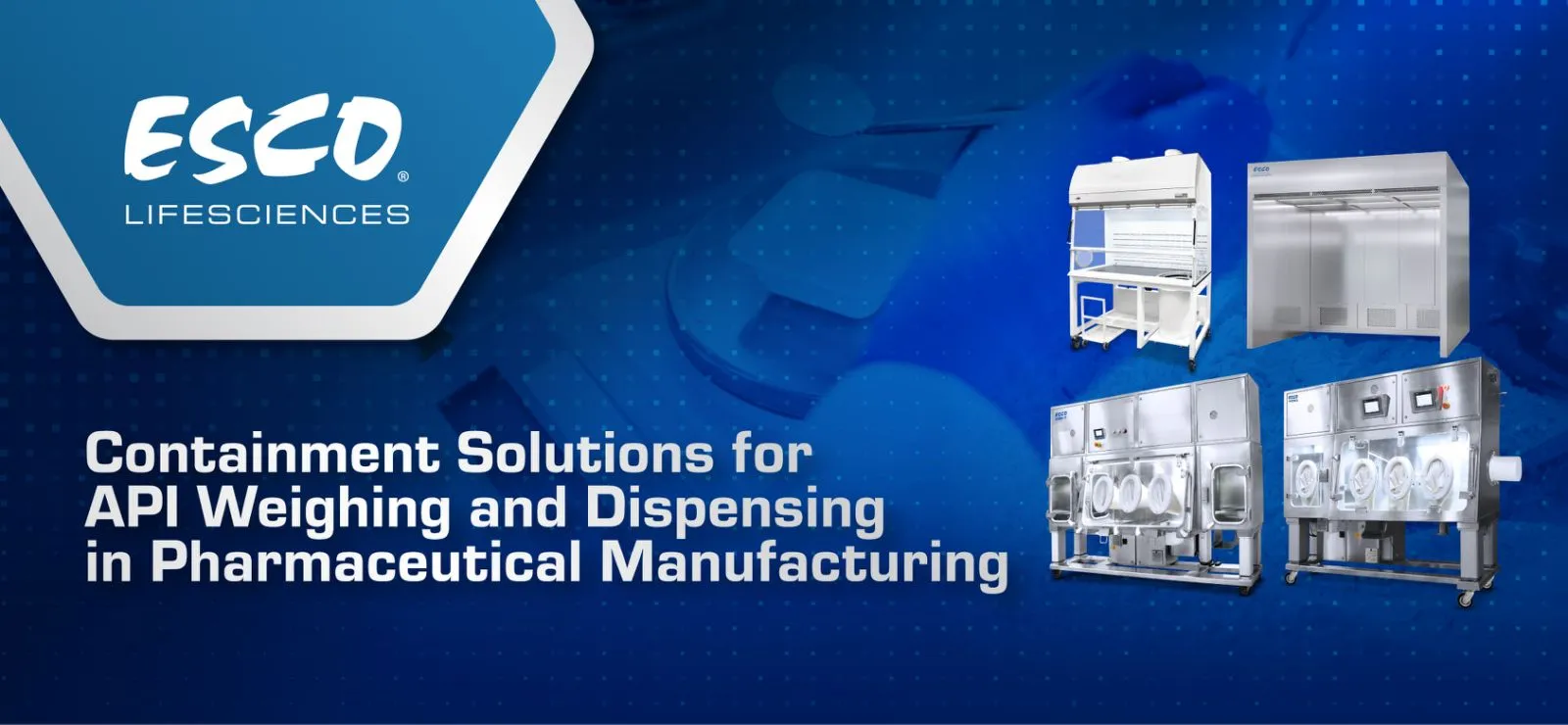
For pharmaceutical manufacturing, EHS specialists and engineering teams select containment equipment for API weighing, dispensing, and related powder-handling operations.
Medicine is one of the most critical things humans need. Medicines help prevent, treat, or manage disease and relieve symptoms. In pharmaceutical manufacturing, medicine is generally produced using Active Pharmaceutical Ingredients (APIs) and excipients, where APIs are the chemically and biologically active components that provide the intended therapeutic effect or help prevent disease (Kumar et al., 2022).
This article walks through how Occupational Exposure Bands (OEB) and Occupational Exposure Limits (OEL) drive containment decisions during API weighing and dispensing, the regulatory framework behind those decisions, and how to match a containment engineering control to a compound’s potency and process.
API Handling Challenges
Handling APIs during dispensing, especially during weighing, can create one of the highest exposure risks for operators because of airborne dust, spills, and direct contact. This risk is especially important for high-potency APIs, which require suitable engineering controls and containment strategies to protect both personnel and create a reliable process (United States Pharmacopeial Convention, 2019).
Hazard Assessment and Exposure Criteria
Before selecting a containment strategy, the potential hazard of the API and the anticipated exposure during handling should be evaluated. Occupational Exposure Band (OEBs) and Occupational Exposure Limit (OELs) provide useful inputs to this assessment. However, equipment selection must also consider the quantity handled, powder characteristics, process steps, transfer method, cleaning method, frequency of handling, and required containment performance. Two complementary approaches are used across the industry for this initial risk quantification step:
NIOSH Occupational Exposure Banding Process
The National Institute for Occupational Safety and Health (NIOSH) describes a structured, tiered approach, a decision-making logic that combines available toxicological, pharmacological, and physicochemical data to sort a substance into a qualitative hazard band even before a numeric OEL exists. The fewer or weaker the data available, the more conservative (higher) the assigned band tends to be, so the process can be applied early in development when data are limited.
For pharmaceutical materials, hazardous drug identification should be performed separately from the OEB assignment. The NIOSH List of Antineoplastic and Other Hazardous Drugs in Healthcare Settings can be used as an initial reference. However, the absence of an API from the list should not be interpreted as confirmation that it is non-hazardous. Available toxicological, pharmacological, reproductive-toxicity, genotoxicity, carcinogenicity, and organ-toxicity information should be evaluated using the organization's hazardous-drug assessment procedure (NIOSH, 2019).
Health-based Exposure Limits
The European Medicines Agency's guideline on setting health-based exposure limits (HBELs), commonly expressed as a Permitted Daily Exposure (PDE), describes a toxicological, dose-based method for deriving a quantitative exposure limit once sufficient data are available. This is generally the basis for a compound-specific OEL, which is a more precise figure than a qualitative band (EMA, 2014).
OEB and OEL Classification
OEBs and OELs are used to characterize the potential health hazard of a compound and to support the selection of appropriate engineering controls.
An OEB is a qualitative hazard-assessment approach used to support chemical risk-management decisions when a compound-specific OEL is unavailable. The NIOSH Occupational Exposure Banding process uses available toxicological, pharmacological, and physicochemical information to place a substance into a hazard band (NIOSH, 2019).
NIOSH defines five exposure bands, from A to E. Band A corresponds to the highest allowable inhalation exposure concentration range while band E corresponds to the lowest exposure range and is generally associated with substances of greater health-hazard potency (Figure 1).

Figure 1. NIOSH occupational exposure bands and associated inhalation exposure-concentration ranges for particulates/dusts and gases/vapors (McKernan et al., 2016)
An OEL is a quantitative airborne concentration value derived from a specific substance to protect workers from adverse health effects. Where a scientifically established, compound-specific OEL is available, it provides a more precise basis for exposure assessment and control than a qualitative band (Schneider et al., 2022). OELs can be obtained from authoritative sources, including OSHA Permissible Exposure Limits (PELs), NIOSH Recommended Exposure Limits (RELs), ACGIH Threshold Limit Values (TLVs) and relevant national occupational health authorities.
OEB Systems are not standardized across the pharmaceutical industry. Companies, consultants, and equipment manufacturers may use different band names, numbers of categories, and airborne-concentration ranges. Consequently, an OEB designation should always be interpreted according to the classification system used by the organization that assigned it.
-
Regulatory Framework
There is no single regulation that addresses API weighing and dispensing in isolation. Instead, several overlapping frameworks are relevant depending on region and setting.
USP <800>, titled Hazardous Drugs — Handling in Healthcare Settings, is a U.S. standard developed primarily for pharmacies and healthcare facilities. It is frequently cited across the pharmaceutical industry as a well-developed reference framework for hazardous-drug handling principles, receipt, storage, compounding, dispensing, administration, and disposal, and it explicitly identifies weighing and other manipulations as exposure-prone activities requiring engineering controls. However, because its scope is healthcare settings, manufacturing sites should treat it as an informative reference rather than as the controlling regulation for a manufacturing operation (United States Pharmacopeial Convention [USP], 2019).
For pharmaceutical manufacturing specifically, the more directly applicable framework is EudraLex Volume 4 (EU GMP) and the aligned PIC/S Guide to GMP, particularly the chapters addressing Quality Risk Management and the requirements for premises and equipment used in weighing and dispensing operations. These sources frame containment selection as an outcome of a documented risk-based assessment (informed by the OEB/OEL classification discussed above) rather than prescribing a single mandatory control for every situation.
Risk-Based Containment Solutions
Because OEB systems are not fully standardized across the pharmaceutical industry, the OEB designation assigned to an API should always be interpreted according to the classification framework used by the relevant organization. For the purposes of this section, the following containment recommendations are based on Esco’s published OEB/OEL guidance. They are intended as a practical reference for preliminary equipment selection and should not replace a compound-specific toxicological assessment, or documented process of risk assessment (Esco Pharma. (n.d.).
In Esco’s guidance, APIs are grouped into OEB categories according to their OEL range, toxicological or pharmacological properties, and anticipated potency. The guidance ranges from OEB 1 for materials with OELs above 1,000 µg/m³ to OEB 7 for materials with OELs below 0.001 µg/m³, or below 1 ng/m³. As the acceptable airborne exposure limit decreases, the recommended containment approach progresses from ventilation containment and open handling controls to enhanced downflow containment and ultimately fully enclosed isolator technology.
The OEB/OEL range is only one part of the equipment selection process. The required containment solution must also consider powder dustiness, particle size, quantity handled, duration and frequency of the task, material-transfer method, and whether the process generates additional powder energy or dust, such as through milling, charging, or vigorous dispensing. Esco notes that its OEB guidance is intended as a rule of thumb and that each application must be assessed individually.
The following ranges and equipment examples are specific to Esco's OEB/OEL guidance and should not be equated directly with the NIOSH A-E banding system shown in Figure 1. The two systems use different band structures and exposure ranges.
Esco OEB
Esco OEL range
General containment approach
OEB 1
>1,000 to 5,000 µg/m³
General ventilation containment
OEB 2
>100 to ≤1,000 µg/m³
Ventilation containment or open flowhoods, depending on the application
OEB 3
>10 to ≤100 µg/m³
Downflow booths, ventilated balance enclosures, or flowhoods
OEB 4
>1 to ≤10 µg/m³
Higher-containment VBE or DFB configurations; small-volume operations may use downflow and inflow airflow controls; isolator technology may be appropriate depending on the process
OEB 5
0.01 to <1 µg/m³
High Containment Isolator/Negative pressure-turbulent flow isolator
OEB 6
0.001 to 0.01 µg/m³
High Containment Isolator/Negative pressure-turbulent flow isolator
OEB 7
<0.001 µg/m³, below 1 ng/m³
High Containment Isolator/Negative pressure-turbulent flow isolator
Source: Esco OEL/OEB guidance. The ranges and equipment recommendations are guidance only. Final containment selection must be based on the specific material, process, and risk assessment.
Using the Esco OEB/OEL guidance above as a reference. The following sections describe typical containment options for API weighing and dispensing. The equipment categories are presented as application guidance. The final suitability must be confirmed against the user’s process conditions and required containment performance.
OEB 3-4: Ventilated and Downflow Containment for Weighing and Dispensing
Under Esco’s OEB/OEL guidance, OEB 3 materials have an OEL range of more than 10 to 100 µg/m³, while OEB 4 materials fall within a range of more than 1 to 10 µg/m³. For these applications, a Ventilated Balance Enclosure (VBE) or Downflow Booth (DFB) may be suitable since it delivers the containment performance required for the material and process.
A VBE is generally suitable for small-scale weighing, sampling, or dispensing activities where a balance is operated within a ventilated work area. A DFB is typically more suitable for larger containers, higher powder quantities, drum handling, bulk dispensing, or activities involving multiple operators. For OEB 4 materials, Esco’s guidance indicates that higher-containment configurations or additional engineering controls may be required, depending on the quantity handled, dustiness, process energy, and transfer method.
Standardized Measurement of Equipment Particulate Airborne Concentration (SMEPAC) testing can be used to assess the containment performance of the selected equipment under representative operating conditions. It does not determine the API’s OEB or OEL. Instead, it provides process-specific evidence of how effectively the selected engineering control limits airborne particulate exposure during the tested activity.
Ventilated Balance Enclosure (VBE)
A suitable option for small-scale weighing, sampling, and dispensing where the balance is operated inside a ventilated enclosure
Downflow Booth — Gen 2 (DFBG2)
Supports operator protection from harmful or sensitizing substances during large-scale powder and solvent handling. Downward laminar airflow is designed to sweep particulates away from the operator's breathing zone.
Downflow Booth — Gen 3 (DFBG3)
Next-generation downflow booth with enhanced airflow management and ergonomics, suited for higher-throughput dispensing of hazardous powder compounds.
-
OEB 5-7: High-Containment Isolator Solutions
Based on Esco’s OEB/OEL guidance, OEB 5 covers compounds with OELs from 0.01 to less than 1 µg/m³, OEB 6 covers 0.001 to 0.01 µg/m³, and OEB 7 includes compounds below 0.001 µg/m³ or below 1 ng/m³. For these very potent materials, Esco generally recommends isolator technology because it provides a physically enclosed barrier between the operator and the product-handling area.
The Containment Barrier Isolator-Turbulent (CBI-T) and the Weighing and Dispensing Containment Isolator (WDCI) may be considered for high-containment non-sterile weighing, dispensing, and powder handling processes. The final selection should be based on the process layout, quantity handled, material transfer arrangement, cleaning strategy, required ergonomics, weighing setup, and validated containment performance. Both systems are non-sterile containment solutions and should not be described as equipment for sterile or aseptic processing.
Containment Barrier Isolator – Turbulent (CBI-T)
Provides operator and product protection during high-containment handling of hazardous powders under turbulent airflow conditions, for general manipulation of ultra-high-potency materials.
Weighing & Dispensing Containment Isolator (WDCI)
Purpose built for precise weighing and dispensing of ultra-high-potency hazardous compounds within a fully contained workspace, combining verified containment with integrated precision-weighing hardware.
Conclusions
Selecting containment equipment for API weighing and dispensing requires a process-specific and risk-based approach. OEB and OEL data provide an important starting point, but the final selection should also consider the material quantity, powder properties, handling steps, operator interaction, transfer method, and cleaning requirements.
The appropriate solution should be specified and qualified for the intended application rather than selected from an OEB category alone. Where required, SMEPAC testing can provide objective evidence that the selected containment system performs effectively under representative operating conditions.
By combining a documented hazard assessment with suitable engineering controls and process verifications, pharmaceutical manufacturers can support personnel protection, minimize ter risk of cross-contaminations, and maintain reliable dispensing operations.
Not sure which containment fits your compound's OEB profile? Our team can walk through your process requirements and recommend the right VBE, DFB, CBI-T, or WDCI configuration — [Contact Us].
Bibliography
Esco Pharma. (n.d.). OEL / OEB. Retrieved September 6, 2026, from https://www.escopharma.com/solutions/oel-oeb
EudraLex Volume 4 — EU Guidelines for Good Manufacturing Practice for Medicinal Products for Human and Veterinary Use, and the PIC/S Guide to Good Manufacturing Practice, particularly the chapters on Quality Risk Management and Premises & Equipment, are referenced in Section 4 for the manufacturing-specific regulatory context.
European Medicines Agency. (2014). Guideline on setting health-based exposure limits for use in risk identification in the manufacture of different medicinal products in shared facilities. EMA/CHMP/CVMP/SWP/169430/2012.
Kumar, V., Bansal, V., Madhavan, A., Kumar, M., Sindhu, R., Awasthi, M. K., Binod, P., & Saran, S. (2022). Active pharmaceutical ingredient (API) chemicals: a critical review of current biotechnological approaches. In Bioengineered (Vol. 13, Number 2, pp. 4309–4327). Taylor and Francis Ltd. https://doi.org/10.1080/21655979.2022.2031412
McKernan, L., Seaton, M., & Gilbert, S. (2016). The NIOSH decision logic for OEBs: applying occupational exposure bands. The Synergist March.
NIOSH. (2019). Technical report: The NIOSH occupational exposure banding process for chemical risk management. By Lentz TJ, Seaton M, Rane P, Gilbert SJ, McKernan LT, Whittaker C. Cincinnati, OH: U.S. Department of Health and Human Services, Centers for Disease Control and Prevention, National Institute for Occupational Safety and Health, DHHS (NIOSH) Publication No. 2019-132, https://doi.org/10.26616/NIOSHPUB2019132
Schneider, K., Dilger, M., Drossard, C., Ott, H., & Kaiser, E. (2022). Derivation of occupational exposure limits: Differences in methods and protection levels. Journal of Applied Toxicology, 42(5), 913–926. https://doi.org/10.1002/jat.4307
United States Pharmacopeial Convention [USP]. (2019). <800> Hazardous Drugs-Handling in Healthcare Settings. In USP compounding compendium. United States Pharmacopeial Convention.