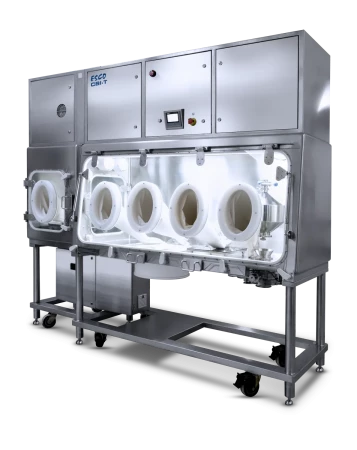
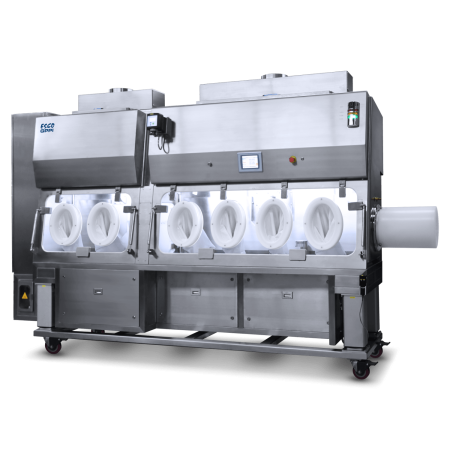
.webp "Operational Excellence Aseptic Platform Isolator")

Operator Protection

Product Protection

Environmental Protection

Clean Air
Operational Excellence Aseptic Platform Isolator
Esco’s Operational Excellence Aseptic Platform Isolator (OxAP) provides a controlled environment for aseptic processing and sterile product handling. By separating the critical working area from operators and the surrounding room, it helps manufacturers manage contamination risks throughout their process. The platform is designed to support contamination control strategies and EU GMP Annex 1 compliance efforts.
Suitable for aseptic filling, cell processing, and aseptic material transfer, OxAP accommodates workflows that require protected product handling and controlled movement of materials. A choice of transfer-chamber configurations and optional accessories allows manufacturers to select an arrangement suited to their process needs, material flow, and facility layout.
Applications
- Aseptic processing
- Aseptic filling
- Cell processing
- Aseptic material transfer
- Integrated NHP bio-decontamination. The Nebulized Hydrogen Peroxide system is designed to achieve a 6-log microbial reduction. Fine aerosol distribution supports coverage throughout the main and transfer chambers while enabling faster bio-decontamination cycles.
- Heavy gauge chamber construction. The 3.0 mm SS316L work chamber has fully welded joints and coved internal corners for durability and ease of cleaning.
- Rear wall racking and hanging bar. Integrated mounting points and a hanging bar support convenient process access and effective bio-decontamination exposure.
- Space saving sliding internal door. The sliding door between the main and transfer chambers minimizes intrusion into the working area and maximizes usable chamber space.
- Integrated controls and records. A 15-inch Allen-Bradley HMI and PLC provide centralized operation and monitoring, data logging, and PDF cycle reports.
- Catalytic converter coverage. Converters treat air from every chamber exhaust and the main-chamber recirculation loop to reduce hydrogen peroxide exposure during aeration and normal operation.
- Four glove main chamber. Four glove ports provide access across the 1900 mm-wide isolator chamber. Non-gloved transfer chambers support material transfer between the working area and surrounding room.
Other Features
Details marked † are retained from the original draft and require engineering confirmation before publication.
- Filtration. H14 HEPA supply and exhaust filtration supports a controlled aseptic environment.
- Pressure integrity. Automated chamber integrity testing is performed before each decontamination cycle. The system is designed to meet <5% chamber volume per hour (prior to each decontamination)
- Door seals. Inflatable seals on all doors support the chamber barrier.
- Environmental monitoring. Real-time temperature and relative humidity monitoring is standard in all chambers. Viable air samplers and non-viable particle counters are available as options.
- Particle monitoring integration. Mechanical and control provisions support particle-monitoring equipment integration.
- Facility integration. A standard relay contact supports connection to facility systems.
Confirm the availability and scope of each marked feature before removing the review markers. Brochure-confirmed specifications and accessories are listed in their respective sections.
OxAP is available with a four-glove main chamber and either one transfer chamber on the left or right, or two transfer chambers on the left and right. All configurations operate under positive pressure.
Model code guide
OX-AP-4G-P-B
|
Code
element
|
Meaning
|
|
OX
|
Operational
Excellence isolator unit
|
|
AP
|
Aseptic
Processing
|
|
4G
|
Four
gloves
|
|
P
|
Positive
pressure
|
|
L / R / B
|
Left /
right / left and right transfer chambers
|
The Operational Excellence model family also includes ST for Sterility Testing (OxST).
|
OxAP
model
|
Transfer
chamber configuration
|
|
OX-AP-4G-P-L
|
One
transfer chamber on the left
|
|
OX-AP-4G-P-R
|
One
transfer chamber on the right
|
|
OX-AP-4G-P-B
|
Two
transfer chambers, left and right
|
Overall unit dimensions
Dimensions from the original webpage draft are retained below for review and require confirmation against the approved engineering drawing.†
- Four gloves with one transfer chamber: 3065 × 1080 × 2430 mm (W × D × H).†
- Four gloves with two transfer chambers: 3747 × 1080 × 2430 mm (W × D × H).†
OxST sterility testing variant
The Operational Excellence family includes OxST for sterility testing. The original draft describes this variant as incorporating an integrated sterility test pump, a floor-level drain, and a cable pass-through for foot-pedal operation.† These provisions support sterility testing workflows; the exact standard configuration and any dimensional differences require confirmation.
Chamber specifications
|
Parameter |
Four
glove isolator chamber |
Transfer
chamber |
|
External
dimensions (W × D × H) |
1950 ×
830 × 815 mm |
665 × 548
× 896 mm |
|
Internal
dimensions (W × D × H) |
1900 ×
720 × 795 mm |
609 × 524
× 828 mm |
|
Airflow
pattern |
Unidirectional |
Turbulent |
|
Airflow
regime |
Recirculating |
Single
pass |
|
Operating
pressure |
Positive
40 ± 5 Pa |
Positive
20 ± 5 Pa |
|
Exhaust
flow volume |
Approximately
595 m³/h |
Approximately
520 m³/h |
Dimensions above refer to the chamber dimensions listed in the brochure, rather than the overall installed unit footprint.
Constructions and performance
|
Parameter |
Specification |
|
Chamber environment |
Grade A / ISO Class 5 |
|
Internal chamber |
3.0 mm stainless steel 316L |
|
External chamber |
3.0 mm stainless steel 304 |
|
Outer doors |
16 mm tempered glass |
|
Inner doors |
16 mm tempered glass |
|
Internal surface finish |
≤ 0.4 Ra |
|
Supply filtration |
HEPA H14 with gasket seal and integral mesh guard |
|
Supply filter efficiency |
99.995% at Most Penetrating Particle Size (MPPS), as per EN
1822:2009 |
|
Exhaust filtration |
HEPA H14 with gasket seal and integral mesh guard |
|
Exhaust filter efficiency |
99.995% at MPPS, as per EN 1822:2009 |
|
Downflow velocity |
0.45 m/s ± 20% |
|
Sound level |
≤ 80 dBA |
|
Chamber lighting |
≥ 600 lux |
Bio-decontamination controls and utilities
|
Parameter |
Specification |
|
Bio-decontamination |
Integrated Nebulized Hydrogen Peroxide system, designed to
achieve a 6-log microbial reduction |
|
Chamber cycle capability |
Independent main- and transfer-chamber bio-decontamination |
|
Catalytic treatment |
Every chamber exhaust and the main-chamber recirculation
loop |
|
Automated pressure-hold test |
Daily routine before each decontamination; <5% chamber
volume per hour |
|
HMI |
15-inch Allen-Bradley Optix |
|
Control system |
Allen-Bradley CompactLogix 5380 PLC |
|
Records |
Data logging and PDF cycle reports |
|
Electrical requirement |
208–240 VAC, 50/60 Hz, single phase |
|
Compressed air requirement |
Minimum 6.2 bar(g), maximum 12 bar(g); maximum flow 1000
L/min |
The following options are available for the OxAP platform.
|
Option
|
Description
or availability
|
|
Non-viable
particle counter
|
Optional
particle monitoring equipment.
|
|
Viable
air sampler
|
Optional
viable air monitoring equipment.
|
|
Sterility
test pump
|
Mechanical
integration includes an automatic drain valve, cable access, and a test pump
cut-out.
|
|
Wired
glove leak tester
|
Optional
wired glove leak testing.
|
|
Wireless glove leak tester
|
Optional
wireless glove leak testing.
|
|
Rapid
transfer port
|
RTP
Ø105/190/270: Alpha, Beta Canister, or Beta Line. Available only for the
single-transfer-chamber configuration, replacing the outlet transfer chamber.
|
|
Customized
racking
|
May be
offered on request, subject to confirmation. Standard racking is included.
|
Controlled airflow
The main chamber provides a Grade A / ISO Class 5 environment with unidirectional, partially recirculating airflow. Transfer chambers use turbulent, single-pass airflow. Positive pressure is maintained at +40 ± 5 Pa in the main chamber and +20 ± 5 Pa in the transfer chambers to help prevent ingress of contaminants from the surrounding room.
Air enters through the upper front inlets, passes through inlet filters and supply fans, and flows downward through supply filters into the chambers. It is drawn beneath the chamber grilles and through exhaust filtration and catalytic treatment. A portion of the main-chamber air recirculates, while transfer-chamber air is fully exhausted. Exhaust air is discharged through the side of the unit.

Controlled material transfer
Materials enter and leave through dedicated transfer chambers, protecting the main working area from direct exposure to the surrounding room. Materials are loaded onto an integrated sliding tray. After the outer door is closed and sealed, the transfer chamber runs its own bio-decontamination cycle before the inner-door interlock releases. The tray then extends into the main chamber, bringing materials within operator reach and reducing reach distance and glove fatigue.
The reverse process applies to material removal. Interlocked door sequencing prevents the inner and outer doors from opening simultaneously, avoiding a direct air path between the room and main chamber.
Independent chamber bio-decontamination
The main chamber and each transfer chamber have independent bio-decontamination capabilities. The main chamber can be decontaminated before or after a batch without cycling the transfer chambers. Transfer chambers can be decontaminated between material transfers while maintaining the main-chamber environment. Cycles are independently validated, documented, and traceable.
An automated pressure-hold test is performed before each decontamination cycle, with a leakage criterion of less than 5% of chamber volume per hour.
.webp)
 Thailand_1.webp)