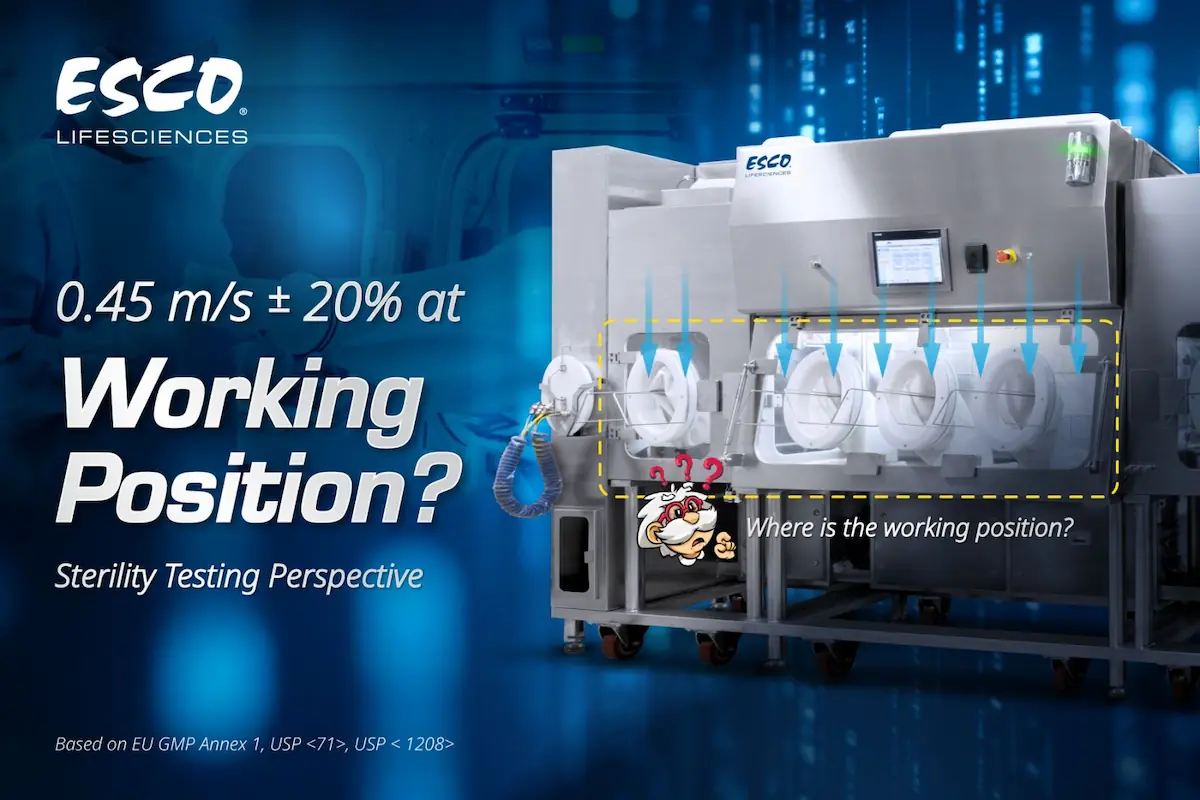
0.45 m/s ±20% at Working Position in Closed Sterility Testing Isolators: Requirement or Convention?
By Esco Lifesciences | Healthcare BU
13 February, 2026
Sterility testing is a mandatory release test for non-terminally sterilized
aseptic products. Before a batch can be released to market, it must
demonstrate the absence of viable microorganisms that could harm patients upon
administration. A confirmed sterility failure is a serious regulatory event
that may result in product recall, warning letters, or even suspension of
manufacturing authorization.
Because of this, sterility testing plays a decisive “go-or-no-go” role in
batch disposition.
At the same time, the integrity of the testing environment is very critical. A
true positive result indicates a potential breach in the aseptic system and
must trigger a thorough investigation, often time-consuming, costly, and
disrupting production process. Even a single sterility test failure, including
a false positive, can result in substantial financial loss when batch
rejection, recall, and revalidation are involved.
Recognizing this impact, FDA (2004) states that sterility testing facilities
should provide environmental controls comparable to those used in
aseptic filling operations. Given the high stakes, the industry has
understandably adopted a conservative approach, ensuring that sterility
testing areas reduce any potential risk of false positives.
From Cleanrooms to Isolators
Sterility testing was first performed in biosafety cabinets or laminar airflow
(LAF) systems with a Grade B background. Over time, many facilities
transitioned to isolator technology. Isolators provide physical separation
between the operator and the process, enabling Grade A conditions within the
chamber even when located in lower-classified rooms.
This shift reduces operational costs associated with maintaining Grade B
environments and complex gowning, while also minimizing operator-derived
contamination as the primary source of both viable and non-viable particles.
Annex 1 and the Airflow Debate
With the revised EU GMP Annex 1 coming into operation on 25 August 2023,
interpretation of airflow requirements in isolators has become a topic of
industry discussion.
Clause 4.19 distinguishes between open and closed isolators:
-
Open isolators require unidirectional airflow to provide continuous
sweeping action over exposed product.
-
Closed isolators may operate with non-fully unidirectional airflow where
simple operations are conducted, provided that turbulent airflow does not
increase contamination risk.
Sterility testing is commonly performed in closed isolators. In many modern
setups, sterility test pumps are integrated into the chamber to control
sample volume and reduce manual manipulation. The process is offline,
conducted according to USP <71>, and separate from the manufacturing
line. Product exposure within the isolator is limited, typically occurring
only when a sterile single-use needle punctures vials containing wetting
solution, sample, or media.
Compared with fill-finish operations, where sterile products are directly
exposed to the environment prior to final sealing, sterility testing
represents a relatively simple and contained activity.
Regulatory and Guidance References
FDA guidance on aseptic processing isolators indicates that turbulent
airflow may be acceptable within closed isolators, which are generally
compact and not housing processing lines.
USP <1208> also notes that airflow in isolators used for sterility
testing may be either unidirectional or turbulent.
Similarly, PIC/S recommendations for isolators used in aseptic processing
and sterility testing (2007) indicate that turbulent airflow isolators can
be acceptable if they are closed systems with validated and effective
decontamination cycles.
These references collectively suggest that airflow design should be
appropriate to the specific process risk.
The Origin of the 0.45 m/s Standard
The commonly cited airflow velocity of 0.45 m/s ±20% originated in cleanroom
design. Its purpose was to maintain stable unidirectional flow and prevent
turbulence that could cause recirculation over exposed sterile materials.
This requirement developed in environments where operators are present
inside the cleanroom as the acknowledged primary contamination source.
This raises a critical question: does the same airflow requirement apply
equally in isolators, where the operator is physically separated from the
process?
Recent debate around EU GMP Annex 1, particularly Clause 4.30, has led some
interpretations to generalize airflow velocity requirements across all
isolator applications, recommending 0.36–0.54 m/s at working height
regardless of process type or risk profile.
However, if closed isolators with turbulent airflow are considered
acceptable under certain conditions, the necessity of enforcing
cleanroom-based velocity criteria for low-risk, simple operations such as
sterility testing becomes questionable.
A Risk-Based Perspective
Ultimately, the justification should be grounded in Quality Risk Management
(QRM).
In fill-finish, working position is clearly defined as a continuously
exposed sterile product path prior to final closure. The purpose of
unidirectional airflow at a defined velocity is logical and necessary in
that context.
Sterility testing in a closed isolator is different. Exposure is brief,
punctured-based, localized, often inside tubing systems and the product is
already container-closed before testing. In such a process, defining a
singular “working position” equivalent to open aseptic processing is not
straightforward. The nature, duration, and mechanism of exposure are
fundamentally different.
If a closed sterility testing isolator:
- Provides Grade A conditions,
- Maintains validated and reproducible decontamination cycles,
-
Uses controlled transfer systems (e.g., RTP, transfer chamber, or
equivalent),
-
Demonstrates environmental control through qualification and monitoring,
then the risk of contamination, particularly operator-derived contamination,
is significantly reduced.
Unidirectional airflow at 0.45 m/s ±20% may provide advantages. It can
support rapid purge, aid in distribution of decontaminating agents, and
reinforce “first air” principles during puncture steps. These are valid
considerations.
But necessity is not the same as benefit. Mandating a specific velocity at
working height for all closed sterility testing isolators adds design
complexity, cost, and project timelines without necessarily providing
proportional risk reduction.
If turbulent airflow is considered acceptable in closed isolators for simple
operations, then applying a cleanroom-derived velocity requirement uniformly
demands clear, process-specific justification. Without that linkage to
identified contamination mechanisms, air velocity becomes a legacy
specification rather than a demonstrated risk control.
The discussion should be framed around alignment: does the airflow design
proportionately address the actual exposure risk of the process?
The more defensible position is not whether 0.45 m/s at working position is
“good” or “bad,” but whether it is scientifically justified for the specific
process risk being assessed.
A truly risk-based approach does not apply standards by inheritance.
It applies them by understanding the contamination mechanisms it is meant to
control.
European Commission. (2022, August).
EudraLex volume 4: EU guidelines for good manufacturing practice for
medicinal products for human and veterinary use. Annex 1: Manufacture of
sterile medicinal products
(effective August 25, 2023).
Agalloco, J. (2016). Paradise lost: Misdirection in the implementation of
isolation technology.
Pharmaceutical Manufacturing, 15(4), 34. Continued online at
pharmamanufacturing.com. Reprinted in
Aseptic Processing Trends eBook (2017, July, pp. 9–17).
Pharmaceutical Inspection Co-operation Scheme (PIC/S). (2007).
Isolators used for aseptic processing and sterility testing (PI 014-3).
Geneva, Switzerland.
United States Pharmacopeia (USP). (2024).
General chapter <1208> sterility testing—Validation of isolator
systems. USP 47–NF 42. Rockville, MD: United States Pharmacopeial Convention.
United States Pharmacopeia (USP). (2024).
General chapter <71> sterility tests. USP 47–NF 42. Rockville,
MD: United States Pharmacopeial Convention.
U.S. Food and Drug Administration (FDA). (2004, October).
Sterile drug products produced by aseptic processing—Current good
manufacturing practice: Guidance for industry.