Engineering Controls for Sterile Compounding — USP Requirements and Equipment Selection
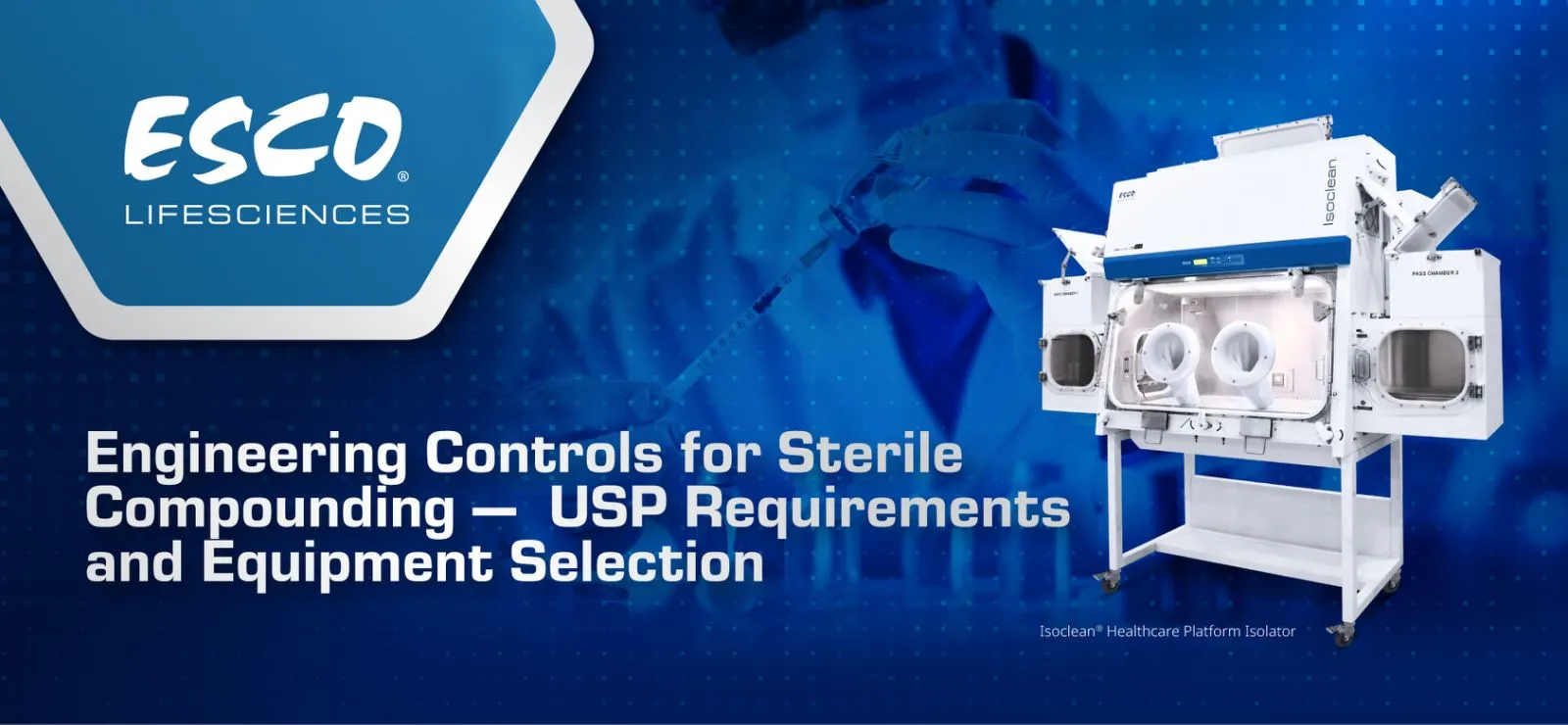
Sterile compounding is one of the most critical activities performed in healthcare pharmacies, where product sterility and personnel safety must be maintained simultaneously. As sterile preparations become increasingly complex and hazardous drugs are more widely used in clinical practice, healthcare facilities face growing challenges in designing compounding environments that comply with regulatory requirements while remaining practical to operate and maintain.
The United States Pharmacopeia (USP) <797> Pharmaceutical Compounding for Sterile Preparations and USP <800> Hazardous Drugs for Handling in Healthcare Settings establish comprehensive requirements for environmental control, engineering controls, facility design, and personnel protection. However, compliance extends beyond selecting an ISO Class 5 primary engineering control (PEC) or constructing a cleanroom. Decisions regarding the type of compounded sterile preparation (CSP), room classification, pressure relationships, workflow, HVAC design, and engineering controls are closely interconnected and should be considered as part of an integrated facility design strategy.
For hospital pharmacists, facility engineers, quality assurance personnel, and project teams, the challenge is often not understanding what the standards require but determining how those requirements translate into practical engineering decisions. Questions such as When is a Laminar Airflow Workbench (LAFW) sufficient? When should a Class II Biological Safety Cabinet (BSC) or Compounding Aseptic Containment Isolator (CACI) be selected? How do facility constraints influence engineering control selection? are frequently encountered during the planning of new compounding facilities or renovation projects.
This article discusses how engineering controls can be selected using a risk-based approach that considers compounding activities, exposure risks, facility limitations, and operational workflow. It also explains how different engineering controls including LAFWs, Biological Safety Cabinets (BSCs), Compounding Aseptic Isolators (CAIs), and pharmaceutical isolators, support compliance with USP <797> and USP <800> while balancing operational efficiency, personnel protection, and long-term facility flexibility.
Engineering Controls as an Integrated System
Engineering controls are often discussed as individual equipment or room requirements. In practice, however, they should be viewed as an integrated system that supports both product sterility and personnel protection throughout the compounding process. Under USP <797> and USP <800>, the selection of a Primary Engineering Control (PEC), Secondary Engineering Control (SEC), room classification, pressure relationship, and airflow strategy are all interconnected. Decisions made at one stage directly influence the requirements of the next.
Rather than beginning with equipment selection, facilities should first evaluate the intended compounding activities, associated risks, and operational workflow. These considerations determine the appropriate CSP category, which subsequently defines the required engineering controls and environmental classifications.
Engineering controls should not be selected independently. For example, choosing a Biological Safety Cabinet (BSC) for hazardous drug compounding also determines the requirement for a negatively pressurized containment secondary engineering control (C-SEC), external exhaust, and specific airflow requirements under USP <800>. Likewise, selecting a Category 2 sterile compounding process requires an ISO Class 7 buffer room and an ISO Class 8 ante-room regardless of the PEC technology selected.
Understanding these relationships early in project planning helps prevent unnecessary redesigns, improves regulatory compliance, and ensures that engineering investments align with operational needs.The Role of Engineering Controls in the Hierarchy of Controls


The Hierarchy of Controls is a widely recognized framework for minimizing occupational hazards, ranking risk mitigation strategies from the most effective to the least effective: elimination, substitution, engineering controls, administrative controls, and personal protective equipment (PPE).
In sterile compounding, elimination and substitution are often impractical because medications must be prepared according to patient-specific clinical requirements. Consequently, engineering controls become the primary strategy for reducing contamination and exposure risks by controlling the environment rather than relying solely on operator technique or PPE.
USP engineering controls can be broadly divided into three categories:Primary Engineering Controls (PEC)
Primary Engineering Controls provide the ISO Class 5 environment where sterile preparations are directly exposed during compounding. Examples include Laminar AiSecondary Engineering Controls (SEC)
Secondary Engineering Controls are the rooms or controlled environments that house the PEC. Their function is to maintain the appropriate room classification, pressure cascade, temperature, humidity, and air cleanliness required to support sterile compounding activities.Supplemental Engineering Controls
Supplemental engineering controls, such as Closed System Drug Transfer Devices (CSTDs), provide an additional layer of protection by reducing hazardous drug exposure during compounding and administration. However, they are intended to complement (not replace) the primary and secondary engineering controls required by USP.
Together, these engineering controls create multiple layers of protection that work collectively to maintain product sterility, minimize occupational exposure, and support regulatory compliance.From USP Requirements to Engineering Decisions
While USP <797> and USP <800> establish the minimum regulatory requirements for sterile compounding, engineering control selection should not begin with choosing a cabinet or cleanroom classification. Instead, facilities should first identify what is being compounded, the associated risks, and the required level of sterility assurance. These factors determine the appropriate engineering controls, environmental classifications, and operational practices needed to achieve compliance.
Rather than viewing USP requirements as independent design criteria, healthcare facilities should consider them as a sequence of engineering decisions that collectively support product quality, personnel protection, and operational efficiency.CSP Categories Determine Engineering Requirements
One of the most significant changes introduced in the revised USP <797> is the categorization of compounded sterile preparations (CSPs) into Category 1, Category 2, and Category 3. Each category reflects increasing levels of environmental control, contamination prevention, and quality assurance, and directly influences the engineering requirements of the compounding facility.
Instead of asking "Which cabinet should I purchase?", facilities should first determine which CSP category best reflects their compounding activities. Once the CSP category has been established, the required room classification, engineering controls, monitoring program, and operational procedures naturally follow.CSP Category
Typical Application
Required Compounding Environment
Typical Facility
Category 1
Immediate or short-term sterile compounding
ISO Class 5 PEC located within an unclassified Segregated Compounding Area (SCA)
Small hospitals, outpatient clinics, physician offices
Category 2
Routine sterile compounding with extended BUDs
ISO Class 5 PEC within an ISO Class 7 buffer room and ISO Class 8 ante-room
Hospital pharmacies, centralized compounding units
Category 3
High sterility assurance with longest allowable BUDs
Category 2 engineering requirements with enhanced environmental monitoring and contamination control strategies
Large healthcare systems, specialized compounding facilities
Air Quality Requirements
Maintaining appropriate air cleanliness is fundamental to sterile compounding because airborne particles can serve as carriers for microorganisms and compromise product sterility. USP <797> adopts the cleanroom classifications defined in ISO 14644-1 to establish acceptable particulate concentrations for different compounding environments.
The Direct Compounding Area (DCA), where sterile products are exposed, must always provide ISO Class 5 air quality under dynamic operating conditions. This environment is created by the Primary Engineering Control (PEC), which supplies HEPA-filtered unidirectional airflow to continuously bathe critical sites in "first air."
For Category 2 and Category 3 CSPs, the PEC is typically installed within an ISO Class 7 buffer room, supported by an ISO Class 8 ante-room. These classified environments reduce the background particle concentration surrounding the PEC and minimize contamination introduced through personnel movement and material transfer.
For Category 1 CSPs, USP <797> permits compounding within an unclassified Segregated Compounding Area (SCA), provided that the ISO Class 5 environment is maintained within the PEC and the applicable Beyond-Use Date (BUD) limitations are observed.
It is important to recognize that ISO classifications are not interchangeable. Higher room classifications are not intended simply to satisfy regulatory requirements; rather, they provide progressively greater contamination control to support increasingly complex compounding activities and longer product storage times.Engineering Controls Should Be Selected Based on Application
One of the most common misconceptions during facility planning is that engineering controls are interchangeable because they all provide an ISO Class 5 environment. In reality, different PEC technologies are designed to address different clinical and operational needs.
The selection process should consider several factors, including:- Whether hazardous drugs will be compounded.
- The required level of personnel protection.
- Desired sterility assurance level.
- Expected compounding volume.
- Available facility space.
- HVAC and exhaust capacity.
- Future expansion plans.
- Maintenance requirements.
- Capital and operational costs.
For example, a Laminar Airflow Workbench (LAFW) and a Compounding Aseptic Isolator (CAI) may both provide ISO Class 5 air quality for non-hazardous sterile compounding. However, the CAI offers greater physical separation between the operator and the critical work zone, reducing the potential for operator-induced contamination. Conversely, a LAFW is generally simpler to operate, easier to maintain, and may be sufficient for facilities with lower compounding complexity.
Similarly, both a Class II Biological Safety Cabinet (BSC) and a Compounding Aseptic Containment Isolator (CACI) are suitable for hazardous drug compounding. However, facilities may choose a CACI when additional containment, reduced environmental contamination, or enhanced operator protection is desired, despite the higher acquisition and maintenance costs.
These examples illustrate that equipment selection should be driven not only by regulatory compliance, but also by operational goals, facility constraints, and long-term risk management.Primary Engineering Controls (PEC)
Primary Engineering Controls (PECs) provide the ISO Class 5 environment where sterile preparations are exposed during compounding. Although all PECs are designed to maintain product sterility, they differ in the level of personnel protection, containment, and intended application. Therefore, equipment selection should be based on the compounding activity, exposure risk, and facility requirements rather than ISO classification alone.PEC
Product Protection
Personnel Protection
Suitable for HD
Typical Application
Esco Solution
Laminar Airflow Workbench (LAFW)
✓
✗
✗
Non-hazardous sterile compounding
Laminar Airflow Cabinets Airstream®
Integrated Vertical Laminar Flow Zone (IVLFZ)
✓
Limited
✗
Integrated ISO Class 5 compounding zone
Ceiling Laminar Airflow (CLAF)
Biological Safety Cabinet (BSC)
✓
✓
✓
(should be Class II or III BSC types A2, B1, or B2)
Non-hazardous and Hazardous drug compounding
Cytoculture® Cytotoxic Safety Cabinet (CYT)
Compounding Aseptic Isolator (CAI)
✓
Limited
✗
Non-hazardous compounding requiring enhanced sterility assurance
Streamline® Closed Restricted Access Barrier System (SLC-RABS) – Positive Pressure
Compounding Aseptic Containment Isolator (CACI)
✓
✓
✓
Non-hazardous and Hazardous sterile compounding requiring enhanced containment
Streamline® Closed Restricted Access Barrier System (SLC-RABS) – Negative Pressure
Pharmaceutical Isolator
✓
✓
Depending on design
Advanced aseptic processing and pharmaceutical manufacturing
Streamline® Compounding Isolator (SCI), Healthcare Platform Isolator (HPI)

Secondary Engineering Controls (SEC)
Secondary Engineering Controls (SECs) provide the controlled environment that supports the operation of Primary Engineering Controls (PECs). In addition to maintaining appropriate air cleanliness, SECs control room pressure, airflow patterns, temperature, humidity, and personnel movement to minimize contamination risks during sterile compounding.
The SEC requirements differ depending on whether non-hazardous or hazardous sterile preparations are compounded.Secondary Engineering Controls for Non-Hazardous CSPs
For Category 2 and Category 3 non-hazardous CSPs, USP <797> requires the PEC to be located within a cleanroom suite consisting of:
- ISO Class 7 Buffer Room
- ISO Class 8 Ante-Room
- Positive pressure relative to adjacent spaces
- Minimum 30 ACPH in the buffer room (with at least 15 ACPH supplied by the HVAC system)
- Minimum 20 ACPH in the ante-room
Positive pressure helps prevent the ingress of lower-quality air into the compounding area, thereby protecting sterile preparations from environmental contamination.Secondary Engineering Controls for Hazardous Drug CSPs
Hazardous sterile compounding under USP <800> requires additional containment measures to protect healthcare personnel and prevent hazardous drug exposure.
Depending on the compounding activity, hazardous drug compounding may be performed in either:
- Containment Secondary Engineering Control (C-SEC) consisting of an ISO Class 7 buffer room with an ISO Class 8 ante-room.
- Containment Segregated Compounding Area (C-SCA) for eligible Category 1 CSPs.
Unlike non-hazardous compounding, hazardous drug SECs must maintain:
- Negative pressure relative to adjacent spaces
- Minimum 30 ACPH for ISO Class 7 C-SECs
- Minimum 12 ACPH for C-SCAs
- External exhaust for Class II BSCs and CACIs
Negative pressure ensures that any hazardous aerosols generated during compounding remain contained within the room and are safely exhausted, minimizing occupational exposure.Requirement
Non-Hazardous CSP (USP <797>)
Hazardous Drug CSP (USP <800>)
Buffer Room
ISO Class 7
ISO Class 7 (Containment)
Ante-Room
ISO Class 8
ISO Class 8
Alternative
SCA (Category 1 only)
C-SCA (where permitted)
Pressure Relationship
Positive
Negative
Buffer Room Air Changes
≥30 ACPH
≥30 ACPH
Segregated Area Air Changes
N/A
≥12 ACPH (C-SCA)
Exhaust Requirement
Not required
Required for Class II BSCs and CACIs
Engineering Considerations
Selecting the appropriate SEC involves more than meeting room classification requirements. During facility planning, considerations such as HVAC capacity, pressure cascade, exhaust routing, personnel and material flow, maintenance access, and available space should be evaluated alongside regulatory compliance. Designing the SEC as part of an integrated workflow helps ensure both product sterility and personnel safety while reducing future operational challenges.Selecting Engineering Controls: A Risk-Based Approach
Selecting engineering controls for sterile compounding is not simply a matter of meeting the minimum requirements of USP <797> and USP <800>. Multiple engineering control configurations may achieve compliance; however, the most appropriate solution depends on the facility's compounding activities, risk profile, operational workflow, and available infrastructure. Adopting a risk-based approach enables healthcare facilities to balance regulatory compliance with operational efficiency, personnel safety, and long-term sustainability.Understand the Compounding Activity
The first step in selecting engineering controls is understanding the type and complexity of sterile compounding performed. Factors such as the frequency of compounding, preparation complexity, required Beyond-Use Date (BUD), and whether hazardous drugs are handled directly influence the choice of Primary and Secondary Engineering Controls.
For example, a hospital pharmacy preparing a limited number of non-hazardous CSPs may find a Laminar Airflow Workbench (LAFW) within a Segregated Compounding Area (SCA) sufficient for Category 1 compounding. In contrast, centralized pharmacy services producing higher volumes of CSPs or preparations requiring extended BUDs will typically require an ISO Class 7 buffer room with an ISO Class 5 PEC. Hazardous drug compounding introduces additional containment requirements under USP <800>, necessitating engineering controls that protect both the product and the operator.Evaluate Risk Beyond Regulatory Compliance
Although USP establishes minimum engineering requirements, healthcare facilities should also consider operational risks that may affect product quality and personnel safety.
These risks generally fall into three categories:
Understanding these risks helps determine whether a standard engineering control is sufficient or whether additional containment, automation, or workflow improvements are warranted.Risk Category
Engineering Considerations
Process Risk
Complexity of manipulations, batch size, compounding frequency, duration of aseptic processing
Exposure Risk
Hazardous drug handling, aerosol generation, powder manipulation, operator exposure
Facility Risk
HVAC capacity, available space, exhaust routing, maintenance accessibility, future expansion
Consider Facility Constraints Early
Engineering controls cannot be selected independently of the facility. During project planning, hospitals should assess whether the existing infrastructure can support the proposed engineering solution.
Key considerations include:
- Available floor space and room layout
- HVAC capacity and pressure cascade
- External exhaust availability for containment equipment
- Electrical supply and medical gas connections
- Ceiling height and service accessibility
- Filter replacement and preventive maintenance access
- Future expansion or renovation plans
For example, while a Class II BSC and a CACI may both support hazardous drug compounding, the preferred solution may ultimately depend on whether the building can accommodate the required exhaust system, utilities, and maintenance access.Optimize Workflow to Reduce Contamination Risk
Engineering controls should support an efficient workflow that minimizes unnecessary personnel movement and material handling. Poor workflow can increase the risk of contamination even when the facility meets the required room classifications.
An effective sterile compounding workflow should consider:
- Personnel movement between classified and unclassified areas
- Material transfer into and out of the cleanroom
- Separation of hazardous and non-hazardous compounding activities
- Waste removal pathways
- Cleaning and disinfection procedures
- Environmental monitoring and routine maintenance activities
Integrating workflow into facility design improves operational efficiency while helping maintain the integrity of the controlled environment.Balance Performance, Cost, and Long-Term Flexibility
The most sophisticated engineering control is not always the most appropriate choice. Facilities should evaluate the total lifecycle impact of the selected equipment, including installation requirements, maintenance, operating costs, training needs, and future scalability.
For example, an isolator may provide enhanced contamination control and reduce operator intervention, but it also requires specialized decontamination procedures, glove integrity testing, and operator training. Conversely, a Biological Safety Cabinet may offer greater operational flexibility for facilities with established cleanroom infrastructure and experienced personnel.
A comprehensive evaluation of both technical performance and operational requirements enables healthcare facilities to select engineering controls that support safe, compliant, and sustainable sterile compounding throughout the facility's lifecycle.
Conclusion
USP <797> and USP <800> establish the regulatory framework for sterile compounding, but achieving compliance requires more than selecting an ISO Class 5 cabinet or constructing a classified cleanroom. Effective sterile compounding facilities are built on a comprehensive engineering strategy that integrates Primary and Secondary Engineering Controls, facility design, workflow, environmental monitoring, and operational practices.
Selecting the appropriate engineering controls should begin with understanding the compounding activity, associated risks, and intended application. Factors such as CSP category, hazardous drug handling, workflow, facility infrastructure, and future operational needs all influence the most appropriate engineering solution. By adopting a risk-based approach, healthcare facilities can optimize product sterility, personnel safety, and operational efficiency while maintaining compliance with USP standards.
As healthcare facilities continue to expand sterile compounding services and prepare increasingly complex therapies, engineering controls will play an increasingly important role in supporting safe and sustainable pharmacy operations. Rather than viewing engineering controls as individual equipment selections, they should be considered as interconnected components of a contamination control strategy that protects patients, healthcare personnel, and the compounding environment.
Esco Healthcare supports this approach through a comprehensive portfolio of engineering control solutions for sterile compounding, including Laminar Airflow Workbenches, Biological Safety Cabinets, Compounding Aseptic Isolators, and Healthcare Platform Isolators. By combining compliant engineering solutions with thoughtful facility design and workflow planning, healthcare providers can develop sterile compounding environments that meet current regulatory expectations while remaining adaptable to future clinical and operational needs.
References
United States
Pharmacopeia. USP <797> Pharmaceutical Compounding—Sterile
Preparations.
United States
Pharmacopeia. USP <800> Hazardous Drugs—Handling in Healthcare
Settings.
Controlled
Environment Testing Association (CETA). CAG-003 & CAG-009 Application
Guides for Sterile Compounding Facilities.
NSF/ANSI 49: Biosafety
Cabinetry—Design, Construction, and Field Certification.
Centers for
Disease Control and Prevention (CDC). Guidelines for Environmental Infection
Control in Health-Care Facilities.
International
Organization for Standardization. ISO 14644-1: Cleanrooms and associated
controlled environments — Classification of air cleanliness by particle
concentration.