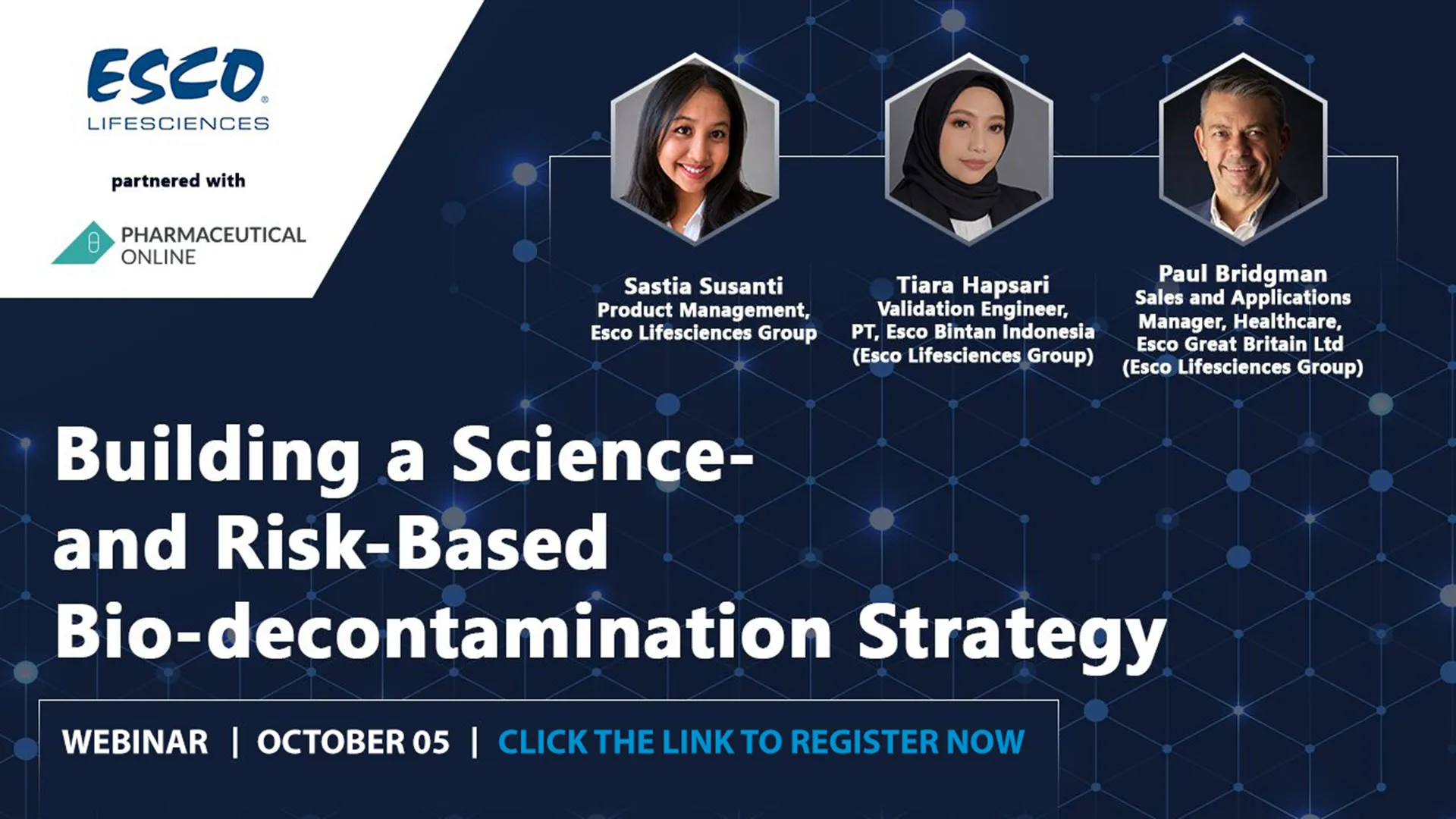
Building a Science- and Risk-Based Bio-decontamination Strategy
Today, bio-decontamination must be designed, scientifically justified, validated, routinely monitored, and periodically reviewed as an integral part of a broader, continuously improving contamination control system. Regulators increasingly expect manufacturers to demonstrate not only that a decontamination cycle works, but also why it works, how it is controlled, and how its continued effectiveness is assured throughout the lifecycle.
What This Webinar Covers
This session walks through a practical, lifecycle-based framework for bio-decontamination in isolators and barrier systems. We will begin by examining how regulatory expectations have evolved, move through the underlying microbial science — hydrogen peroxide inactivation mechanisms, D-values, and log reduction — and into technology selection across VHP, AHP, and NHP systems.
From there, the discussion turns to cycle development and worst-case justification,
how to structure a qualification and validation strategy, including IQ/OQ/PQ, biological/chemical/enzyme
indicators where applicable, and what a robust routine monitoring program should look like once validation is
complete.
Key Learning Objectives
By the end of this webinar, attendees will be able to:
-
Interpret current regulatory expectations - including EU GMP Annex 1, PIC/S PE 009, WHO TRS 1044, and FDA guidance - and translate them into a defensible, documented Contamination Control Strategy for bio-decontamination.
-
Apply core microbial inactivation science, including D-values, log reduction requirements, and the factors that influence hydrogen peroxide efficacy, to justify cycle parameters and select the right technology for a given application.
-
Build a lifecycle validation and monitoring approach, from IQ/OQ/PQ and worst-case cycle development through routine performance monitoring and data integrity practices, that keeps the validated state defensible over the equipment's operational life.
 Sastia Susanti,
Product Management
 Tiara Hapsari,
Validation Engineer
 Paul Bridgman,
Sales and Applications Manager, Healthcare